
How Has This Fruit Been Produced? A Closer Look at Working Conditions in South Africa’s Fruit Sector
In his master’s thesis, Sylvester Neba examines working conditions in South Africa’s fruit export sector. In the interview, he offers insights into his research and the challenges he encountered along the way.
Drescher: Great to finally meet you! We’ve tried to arrange a meeting for some time now, but you have been quite busy…
Neba: Yes, I am taking intense German classes. Since I do not have a scholarship (I am here self-financed), I have been working throughout my master to be able to study. There was very little time aside from work and studies, and my German classes had to take a back seat.
"The topic is relevant because in agricultural value chains there’s an increased risk of social and environmental issues.”
Drescher: So please tell us about your thesis, what is the topic?
Neba: I was conducting a literature search to get an overview of the current understanding of farm workers’ working conditions. This is relevant because in agricultural value chains there’s an increased risk of social and environmental issues, so agriculture accounts for around 70% of child labour and over 12% of forced labour worldwide. To narrow the topic down, I focused on South Africa and its fruit exports.
Drescher: Okay. And why did you choose fruit exports?
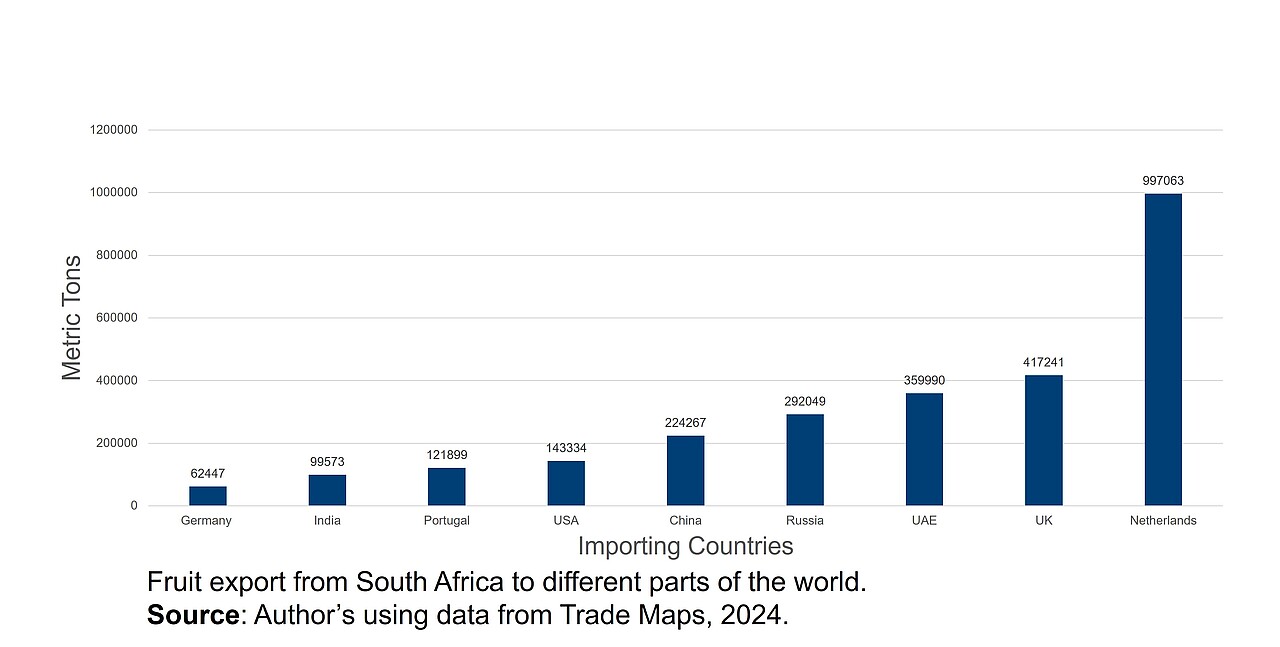
Neba: Actually, South Africa is one of the world’s leading exporters of citrus, grapes, apples and pears. So the citrus sector is kind of a cornerstone of the economy, because it generates significant foreign exchange and provides employment. For those commodities, the most relevant trading partner is the EU. Thus, regulations from the EU are very important for South Africa.
Drescher: I assume you were focusing on a specific regulation, weren’t you?
Neba: Oh yes, everything else would have been way too much! I was looking at the European Union’s Corporate Sustainability Due Diligence Directive (EU-CSDDD). For years, there were voluntary guidelines for companies to ensure human rights, and some companies also did so. The EU-CSDDD, however, is legally binding. With the EU-CSDDD, companies are required to identify, prevent, mitigate and account for risks related to human rights and the environment along their supply chains.
Drescher: In Germany, there’s a similar law, the Lieferkettensorgfaltspflichtengesetz. German is such a beautiful language…
Neba: Yes, Germany started with its LKSG, and now there’s the EU-CSDDD. But to protect human rights this kind of regulations has been around and agreed upon for decades. For example, there are binding commitments since 1966 with the International Covenant on Economic, Social and Cultural Rights (ICESCR) and agreements on core labour standards (like the prohibition of child labour and forced labour) of the International Labour Organization (ILO) from 1998.
But coming back to my thesis, in principle I wanted to know:
- What are the working conditions in South Africa’s fruit export sector?
- How effective are South Africa’s labour laws and enforcement mechanisms in regulating these conditions?
- What are the potential implications of the EU-CSDDD for working conditions in the fruit export sector?
Drescher: Would you share a bit of your working process?
Neba: Well, I developed the research idea all by myself. From time to time, I was presenting my draft, for example to Professor Wieck. But I was most of the time working on my own and managing my time and progress by myself.
Drescher: What kind of data were you working with? And how?
Neba: Well, that was tricky… In total, I had 29 papers, among them 15 academic papers and 14 from institutions or political bodies. Since my supervisor Professor Wieck is a member of the Scientific Advisory Board on Agricultural Policy, Nutrition, and Consumer Health Protection (WBAE) she was guiding me towards some relevant publications there. When I had managed to identify promising papers, I skimmed through them. Everything I identified as relevant for my research question I put in a table. And thus I got an overview of the findings. I used Zotero to keep track of the literature I used. I also used AI to help me find some papers.
Drescher: Sounds as if you found it a bit challenging to find relevant data…
Neba: Yes, getting all the data was the difficult part. So initially I was thinking about my home country Cameroon. However, there is a lack of reliable data sources. Also, Cameroon is a bilingual country (English and French) and I do not know French, so I wanted to have sufficient data available in English. That’s how I turned to South Africa. But even then, it was difficult to actually find articles, I did not expect that.
“The fruit export sector in South Africa generates widespread employment, but much of it remains seasonal and informal.”
Drescher: So in the end you managed. What did you find out?
Neba: So generally, the fruit export sector in South Africa generates widespread employment, but much of it remains seasonal and informal. Particularly for seasonal workers, wages remain insufficient to meet basic living costs.
Also, the management of the agricultural farms is developing strategies to avoid these regulations. For example, not providing contracts. Or hiring for limited time only. Also, some literature I found indicated that management actually puts together a group of people and when the certification body comes, they act as if they were the workers union. So even though South Africa’s labour laws provide comprehensive protections for workers, they are not efficiently implemented. The crucial point here is the limited inspection capacity. If there was better coverage of labour inspectorates, particularly in remote agricultural regions, working conditions could be improved.
Drescher: What else would you recommend politicians in South Africa or other countries to do?
Neba: I found that the communication between the certification bodies and the government should be improved. Because the certification bodies do have the knowledge about issues and flaws that are happening on the ground, but do not have the power to change regulations accordingly. The government however, does, but might not be aware of all of them.
“The EU-CSDDD is an opportunity for reform.”
Drescher: And coming back to the CSDDD: What did you find about implications for working conditions?
Neba: If implemented effectively, the EU-CSDDD may strengthen accountability and encourage more equitable labour governance. It’s an opportunity for reform, so to say. What other authors and I see critically is that governments such as South Africa’s were left out of the drafting process of the Due Diligence Directive. Yet they may be indirectly affected, since sectors in their economies depend on trade with the EU.
Drescher: Writing a master thesis is tough. So how did you experience the process, was there something that helped you when you got stuck?
“When I was writing my thesis, I would have given anything to skip the thesis and complete more modules, or write additional exams.”
Neba: Uff, writing is very hard! Frankly, when I was writing my thesis, I would have given anything to skip the thesis and complete more modules, or write additional exams. Sitting there, all by yourself, confronted with the same topic, it’s hard. Sometimes, I got a bit bored doing the same thing all over again. So I put the thesis aside, did something different to start fresh again. Also, I was meeting friends, for example in the library. So I was writing everywhere: at the library, at home, with friends or alone. So that helped me.
Drescher: Is there anything that you wished you had done differently? Some angle or methodology that you think could have been interesting?
Neba: Looking back, I think I might have selected a quantitative study. I have taken modules in econometrics, so I know how to run statistics using statistical programs such as R and STATA, but in the end my thesis was more qualitative. In the job offers I’ve seen so far, quantitative skills seem to be in greater demand. Even though I personally prefer hearing/reading people’s views and not just looking at the numbers.
Drescher: Now you’ve successfully defended your thesis and your studies here at Hohenheim are coming to an end. What else do you have in mind now that you’re finished? What are your plans for this summer?
Neba: Aside from my German course, I am looking for a job. Currently, I am looking for employment. I am open to anything related to Agricultural Economics. Also, I did not have the opportunity to do much aside from studying and working. So it would be nice to see more of the area, visit Strasbourg and maybe some other European countries.
Drescher: Thank you so much, and best of luck for your future!
For feedback on this online article, please contact Anne Line Drescher.
For subject-related questions about the master’s thesis, please contact Sylvester Neba.