
Designing Minimum Wage Policies: Lessons from Ghana and South Africa
Akwasi Acheampong Asiedu did it - he successfully submitted and defended his master’s thesis “The institutional perspective of the minimum wage: A comparison between South Africa and Ghana” in March 2026. Here, he presents his findings and his experiences during the writing process.
Drescher: Akwasi, congratulations on finishing your thesis! Would you like to share what you have worked on over the last few months?
Acheampong Asiedu: Thank you, it was a long process. In my master’s thesis I compared institutional viewpoints on the implementation of minimum wage policies in Ghana and South Africa.
Drescher: So the minimum wage is intended to fight poverty and income inequality, ensuring that workers receive a minimum amount of money for their work.
"Minimum wage is considered necessary because, especially in times of high unemployment, employers often take advantage of workers by paying them less. Workers have no choice but to accept very low salaries because they need to feed their families, and it’s still better than having no job at all."
Acheampong Asiedu: Yes, and the minimum wage is considered necessary because, especially in times of high unemployment, employers often take advantage of workers by paying them less. Workers have no choice but to accept very low salaries because they need to feed their families, and it’s still better than having no job at all. Also, the idea is that it might be an extra incentive for workers to put in more effort. However, little research exists on minimum wage in African countries. There are studies on specific sectors such as domestic workers and taxi drivers. But what’s often neglected is the role of actors that are involved in pushing the minimum wage onto the agenda, in actually formulating the minimum wage policies and implementing them. Also, I wanted to see how South Africa and Ghana approach the topic, what the are similarities and differences are, and how minimum wage policies can be improved in those two countries. Actually, I am not quite sure how it works in Germany…
Drescher: In Germany, the minimum wage was introduced in 2015. There is a Minimum Wage Commission in place that reviews the minimum wage every two years. Since 2026, it is €13.90 per hour, which apart from a few exceptions, all employees in Germany receive. Coming back to your thesis: Why did you choose the two countries, South Africa and Ghana?
Acheampong Asiedu: South Africa faces two main issues: high unemployment, especially among the youth with 42% unemployment and high income inequality. It’s among the most unequal countries worldwide. However, there have been debates around minimum wage even before the United States introduced one in 1938. Ghana's minimum wage was introduced in the colonial ara in 1939, and since then several minimum wage policies have been implemented.
Drescher: How did you end up with the topic of the minimum wage?
Acheampong Asiedu: Well, I was attending the module “Policies for Sustainability Transitions“, where professors from different departments dive deep into topics such as climate change, food waste, animal welfare and so on. One of the topics that Professor Wieck was presenting was due diligence and that’s when I first came into contact with with the concept of the minimum wage. We also had to write a short paper in the module. So, after I did that, I approached Professor Wieck and we exchanged some ideas… And then I got started.
Drescher: Can you take us a bit through your working process? How did you approach the topic?
Acheampong Asiedu: Honestly, I did a lot of research on actually finding all the relevant documents. Because there are so many documents, but not one website or institution that centralizes all of them. So what I had to do was find all of the documents to actually analyze them.
Drescher: Did you have any software or tools to help you?
Acheampong Asiedu: Yes, I was working with MaxQDA which is very useful if you have a lot of documents to analyze.
Drescher: And for students from Hohenheim, the software is free, too, because the KIM provides a license for it. So after you had brought all the information together, what did you find out?
"Actors or institutions involved in establishing minimum wage policies are crucial."
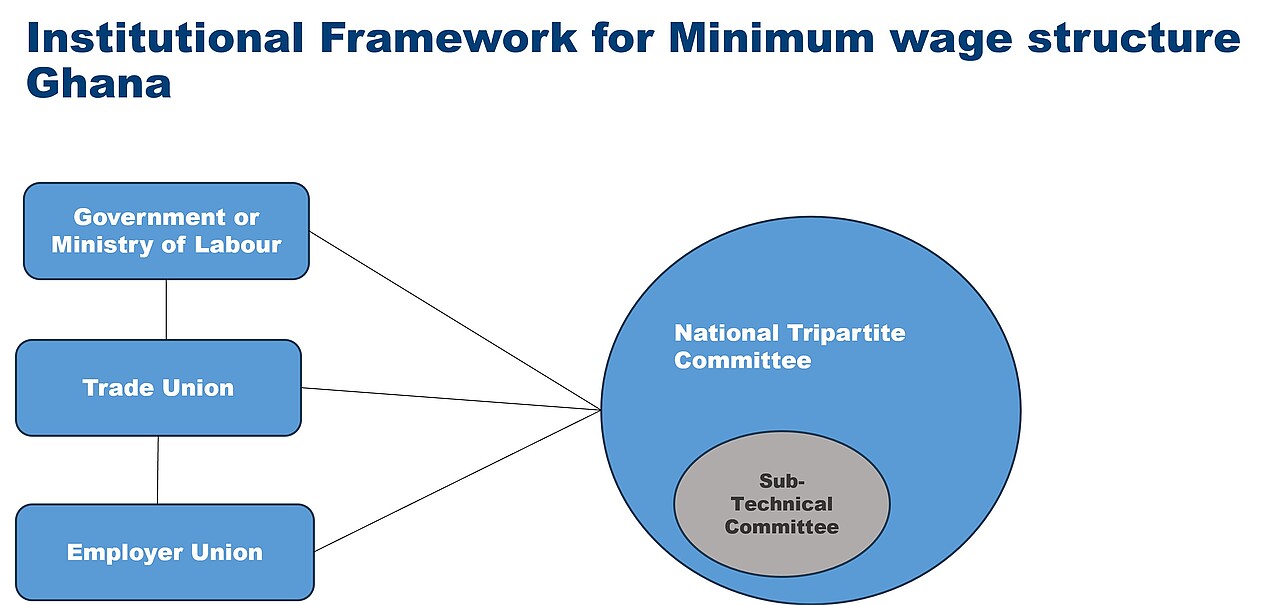
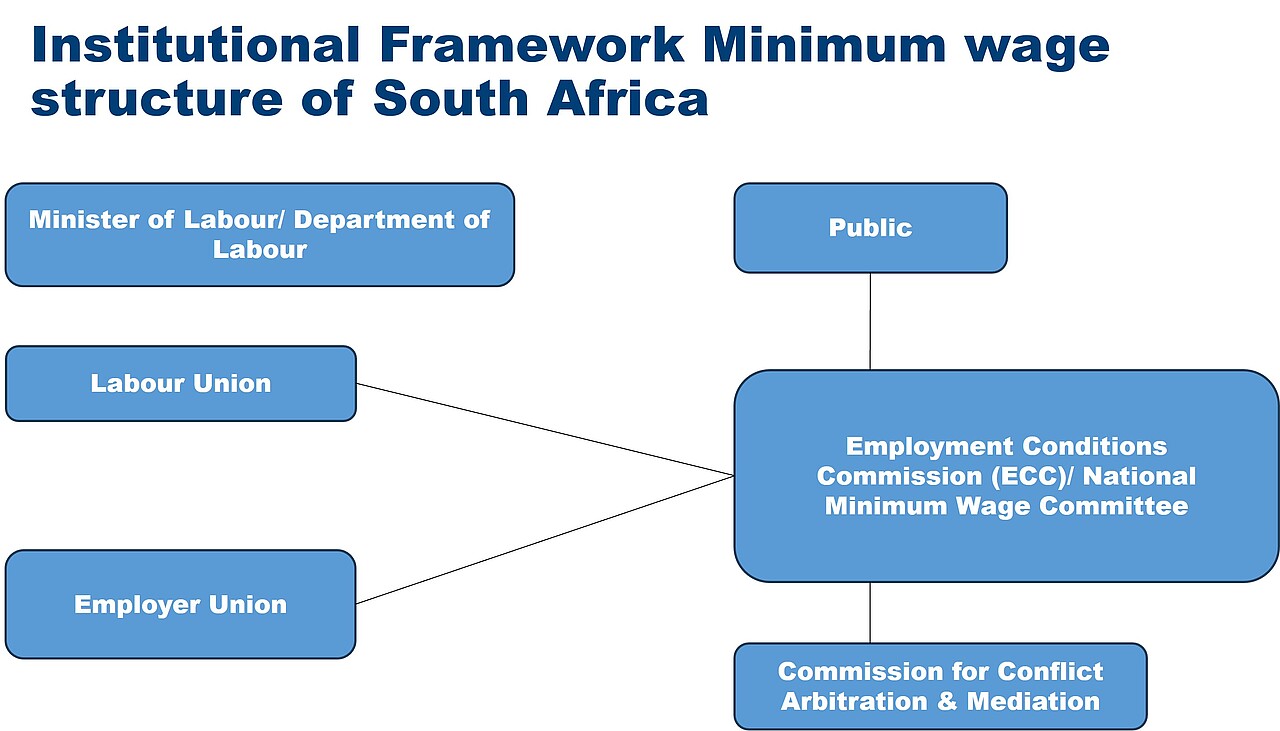
Acheampong Asiedu: Essentially, that actors or institutions involved in establishing minimum wage policies are crucial. The relevant institutions for minimum wage are the National Minimum Wage Commission (NMWC) in South Africa and the National Tripartite Committee in Ghana. These bodies are responsible for recommending the minimum wage policy to the government. Thus, the minimum wage is set and adjusted annually in both countries.
The difference between Ghana’s and South Africa’s minimum wage policies is that Ghana has a single system that is simpler and easier to enforce and monitor. It uses the daily national minimum wage, which applies to all sectors in the country. There is no discrimination among sectors. South Africa’s policy, however, is much more complex, as it considers sectors, geographical location and the strength of employers’ and employees’ unions. This means that strong unions set their minimum wage through the collective bargaining council, while the minimum wage for weak unions is set by the government through sectoral determination.
Drescher: Was there something that you found particularly surprising?
Acheampong Asiedu: I would say how detailed the process for setting the minimum wage in South Africa is. For example, it took three years for the minimum wage for domestic workers to be introduced. Numerous studies were conducted, public hearings were held, and awareness campaigns were launched. In addition, the structure of the committee was very impressive. Compared to Ghana, civil society organizations and independent bodies were represented there, and their opinions carried weight. In Ghana, there were no criteria for introducing the minimum wage. Basically, they rely heavily on the bargaining power of the various groups. I think this leads to injustices, since the government always has the greatest influence at the negotiating table.
Drescher: So now that you’re a bit of an expert: What do your findings imply for South Africa and Ghana?
Acheampong Asiedu: Huh, I’m not sure I am. (laughs) Well, the minimum wage policies in Ghana and South Africa have great potential to reduce poverty. And as I said before, institutions matter. This means that the Departments of Labour and Employment and the National Labour Commission in Ghana and the Department of Labour in South Africa should be strengthened via better funding and capacity building. In Ghana in the informal sector, minimum wage policies are often not complied with, so there should be better mechanisms in place to ensure enforcement. And helping citizens better understand the entire process and how to hold these institutions accountable for their work, I think that’s a recommendation for both countries.
Drescher: If you don’t mind: What have been the challenges while you were writing your thesis? What are your takeaways?
"There are days, where you are very productive, everything is easy and you can write several pages. And then, there are other days. Hard days, when you maybe manage two sentences or nothing at all. It’s tough."
Acheampong Asiedu: Well, as I said before it’s a long process. There are days, where you are very productive, everything is easy and you can write several pages. And then, there are other days. Hard days, when you maybe manage two sentences or nothing at all. It’s tough. For me that was the time when I needed to go out for walks, clear my head and try again.
Drescher: As someone who is also just beginning their thesis, I’ve already been in some small up-and-down phases too…
Acheampong Asiedu: Yes. But know that in the end, you are very proud of what you have accomplished.
Drescher: I can imagine. So what now? Do you have a new project in mind?
Acheampong Asiedu: First, I think I will take some time off.
Drescher: Enjoy! Thank you for your time and for sharing your process.
This interview was conducted and written by Anne Line Drescher. For any feedback on this online article please contact Anne Line Drescher.
For any questions related to his master thesis, please contact Akwasi Acheampong Asiedu.