
Trade relationships between Africa and Europe – A fair competition?
International trade is a dynamic process which is shaped by trade policies. These policies reflect a country’s economic interests and capabilities, political goals and its social values. For Africa, Europe is the most important trading partner. A common belief is that because of the EU’s trade policy, goods from Africa cannot compete on the international market. What does empirical evidence say? The study from Kareem (2025) from the Agricultural and Food Policy Department tries to find out.
The EU as Africa’s Key Trade Partner
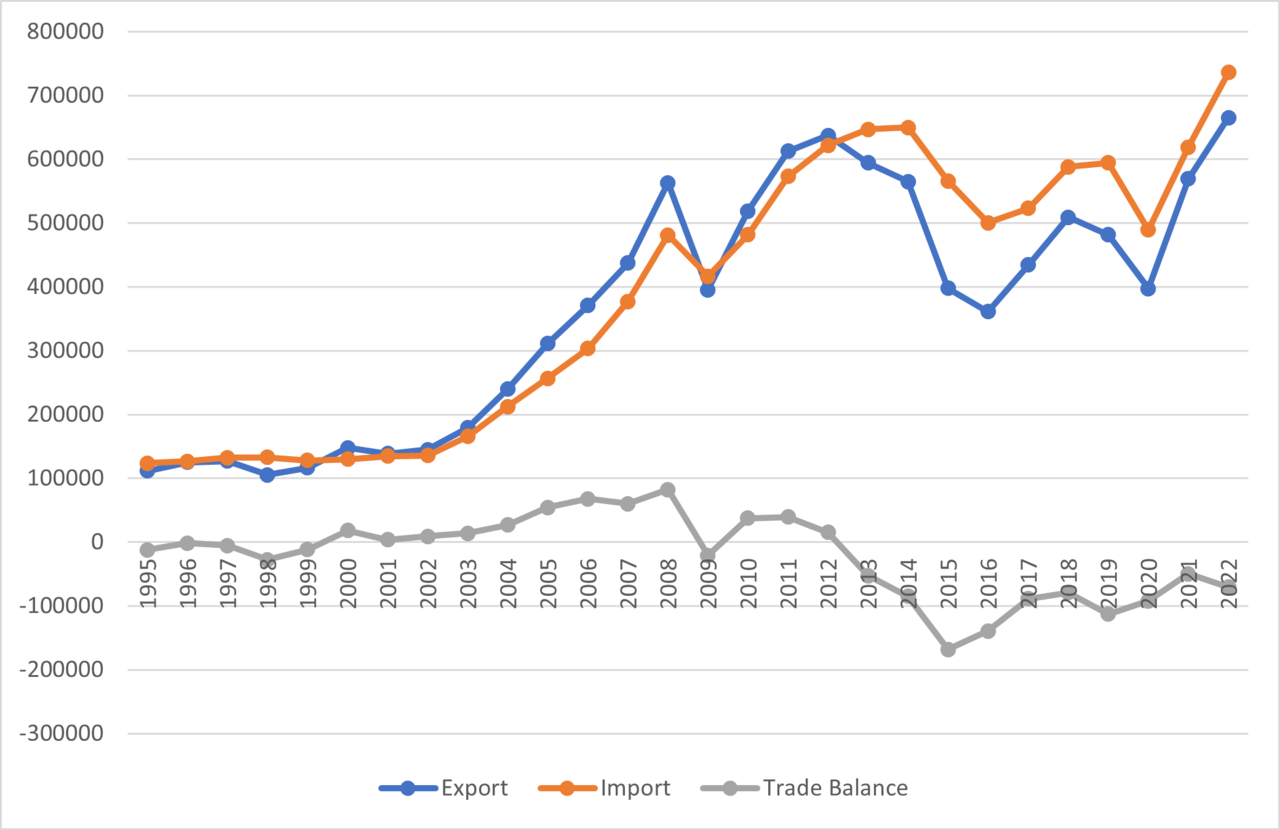
The EU has long been Africa’s most important trading partner, especially for exports. This is partly due to historical colonial ties, which created long-lasting economic links. Over the last three decades, trade in goods between Africa and the EU has grown sharply: the total value tripled between 1995 and 2022. Let’s look closer at which partner was trading what in that period:
- The EU mainly exported manufacturing goods, i.e. finished and processed products such as machinery and vehicles, chemicals and other manufacturing goods to Africa, even though the share of those goods in the overall exports decreased from 76 % (in 2008) to 68 % (in 2021). What was increasing in the same period was the share of agri-food and foodstuff, as well as primary commodities, such as energy and raw materials, that the EU was exporting to Africa: From 22 % to 31 %.
- Africa mainly exported primary commodities (meaning agri-food, foodstuff and materials) to the EU. This share has decreased, though, from 75 % (in 2008) to 61% (in 2021).
- Overall, the increase in trade volume results from the fact that Africa was simply importing more. Since about 2012, Africa has been importing more from the EU than it exports, resulting in a negative trade balance, a so-called “trade deficit”.
How do EU food exports affect Africa?
Several studies have addressed how specifically EU agri-food exports have affected African countries. Taken together, they find that EU food exports help African consumers, since they can buy cheaper food and have more food options to choose from, thus potentially reducing food insecurity. At the same time, African producers and farm workers are hurt if they can no longer compete with the cheaper imports. This means that local factories shutdown and that workers employed in those sectors loose their jobs. If you’re more interested in that, you can find the examples in the study from Kareem (2025).
Diving deeper: What are the EU policies that matter for trade?
What one should keep in mind is that the EU has two main types of policies in place that are especially relevant for trade:
First, there is support for EU farmers and food producers, mostly consisting of subsidies and other support under the Common Agricultural Policy (CAP). These have various effects and intentions within the EU. In the context of international trade, these supports make EU products cheaper and more competitive abroad. Second, there are food safety and quality rules, so-called “SPS measures” (Sanitary and Phytosanitary Standards). They include, for example, pesticide limits, hygiene rules, disease controls, and strict checks at the border. The EU often uses a “precautionary principle”: if there is any doubt about safety, it sets very strict limits (for example, South African citrus fruit was once banned because of a disease concern). These rules are officially about protecting EU consumers and animals; in the context of trade, they act sometimes as barriers to imports.
Additionally, if an African company or country wants to export its goods to the EU, it faces further regulations: different tariffs (import taxes) on some products, entry price systems for some fruits and vegetables (if African exports are “too cheap”, extra duties are added) and the already mentioned SPS rules.
All these policies raise costs for African exporters since they must meet higher standards. These are especially hard to meet because many African countries lack labs, cold storage, inspection systems and other “quality infrastructure”. So the question that arises is:
How do the European Union’s (EU) trade rules and food standards affect Africa’s farmers, food producers and exports?
Approach: What Newton and trade have in common
To answer this question, this article uses trade data for 52 African countries exporting to the EU, focusing on four key products: fish, vegetables, coffee and cocoa.
The author uses a classic trade model that should sound familiar from physics class: gravity. Maybe you know the tale according to which Newton got the idea for his law of gravitation when an apple fell on his head. Translated into trade theory, the gravity model of international trade in principle says: the amount of goods such as apples that falls from one trading partner to the other (the “trade volume”) is determined by the geographical distance and the economic strength (in terms of a large gross domestic product) of the trading partners.
But let’s return to the scientific article: what conclusions does the author reach?
Main findings: How do EU rules affect African exports to the EU?
The impact of EU food safety rules (SPS) on African exports is mixed and depends on the product:
- Vegetables: EU SPS rules reduce Africa’s export competitiveness (exports fall when rules become stricter).
- Cocoa: Also negatively affected; stricter rules strongly reduce competitiveness.
- Fish: No clear significant negative effect found in this study.
- Coffee: No significant negative effect; in some cases, standards can even support exports if producers get help to comply (e.g. training, GLOBALG.A.P., contract farming).
So, the common claim “EU standards always hurt African exports” is too simple: They clearly hurt some products (e.g. vegetables, cocoa). For others (fish, coffee), the effect is weak or not negative, especially where support and infrastructure exist.
What should be done
Based on those findings, there are several implications for both the EU and African countries:
The EU has explicitly stated that it wants to support Africa’s development and reduce poverty on the continent. If the EU truly wants to, it should review how its subsidies and SPS rules affect African producers, recognising Africa’s lower level of infrastructure and technology. The EU should use its trade policy more as a “fair competition” and ‘walk the talk’ by supporting Africa through ‘international social responsibility’.
African countries, especially their consumers, have gained from trade with the EU. If Africa wants to support its producers and become more competitive, there are several options:
- Invest heavily in quality infrastructure, such as building laboratories, inspection services, cold chains, storage, etc.
- Provide training for farmers and firms to meet EU standards.
- Use the room they have under WTO and EU agreements to temporarily protect “infant industries” or “sensitive products” in food (e.g. poultry, dairy, tomato processing).
- Respond to unfair trade practices (e.g. dumping) with their own measures.
- Reduce dependence on food imports in the long run by strengthening domestic food production and regional trade.
- Build more resilient food systems so that shocks like COVID 19 or the Ukraine war do not cause severe food crises.