
Is it still arable land — or already permanent grassland?
What a Hohenheim master’s thesis reveals about rules, authorities and practice in North Rhine-Westphalia and Baden-Württemberg under the new § 6 GAPKondG on permanent grassland
What distinguishes arable land from grassland
When does my arable land stop being arable? For people outside agriculture, this is probably a new question. For many farmers, it is not. For them, the answer determines how flexibly a plot can be used in the future and how much it is worth.
Permanent grassland is considered important for climate and environmental protection: it stores carbon, protects soils and water bodies, and provides habitat for many species. At the same time, grassland is often economically disadvantaged: it is more closely tied to livestock farming and usually has a lower market value than arable land.
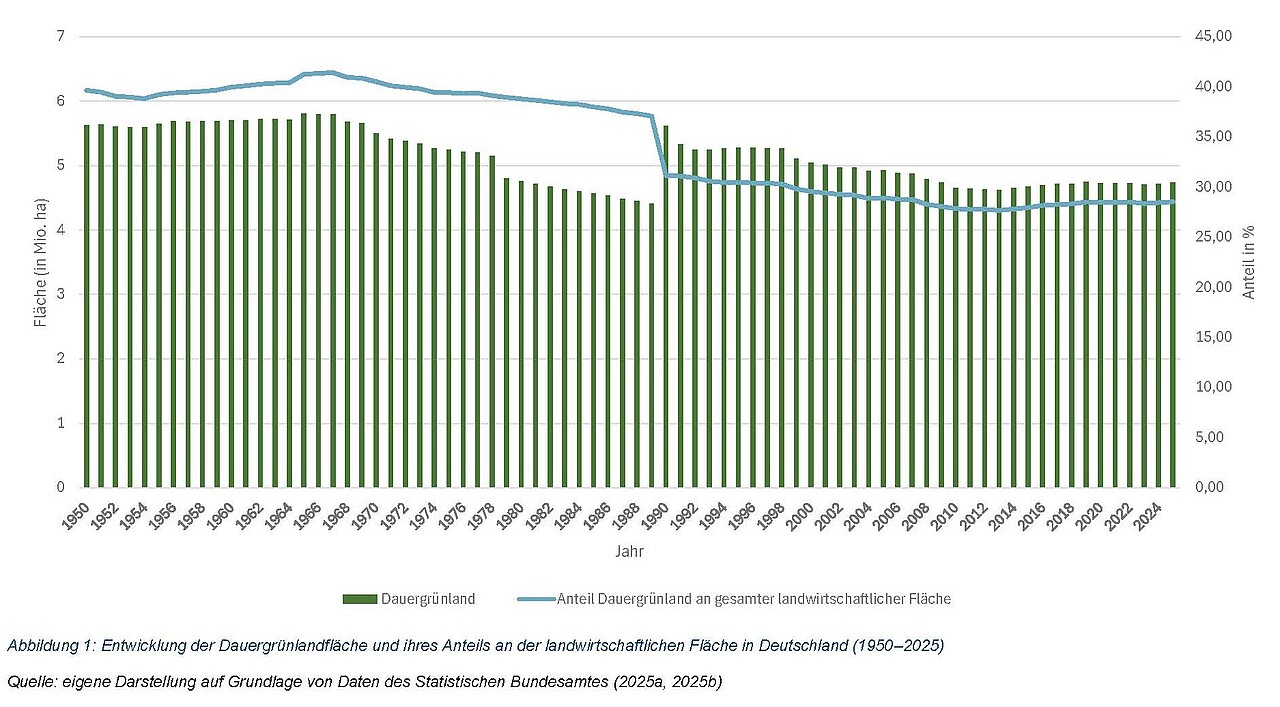
The ecological value of grassland was not always recognised. At the beginning of the Common Agricultural Policy (CAP), there were no support options for farms with permanent grassland; subsidies were linked to arable land. Against the background of structural change in agriculture, this created incentives to plough up grassland and convert it into arable land. The first reforms in 2003 tried to counter this trend and aimed to support and preserve grassland financially for the first time.
Legal foundations relating to grassland
Under subsidy law, the following applies: if an arable plot is used for more than five years for grass and forage crops, is not ploughed, and is not included in a crop rotation, it develops into permanent grassland. And permanent grassland may generally not be ploughed up.
Anyone who wanted to keep using arable land for forage production for longer, for example by growing temporary grass or clover grass, previously had to plough the area and file a ploughing notification (“Pfluganzeige” in German) before the five-year period expired. This reset the five-year clock, and the land retained its arable status. From an environmental and climate perspective, this is questionable, because ploughing can release carbon and increase nitrate leaching.
With the 2023 agricultural reform, § 6 GAPKondG was added: permanent grassland that was newly created from 1 January 2021 onwards may be converted back into arable land without authorisation. The rule is therefore not simply a continuation of the ploughing notification system, but an independent regulatory approach: in the relevant cases, a ploughing notification is no longer required, while at the same time the option is created to regain arable status without much administrative effort. The federal government’s aim was to reduce ploughing notifications, avoid unnecessary ploughing and cut bureaucracy. But were these goals achieved?
This is exactly where Hannah Gundlach’s master’s thesis comes in. It examines whether the rule introduced in 2023 under § 6 GAPKondG actually leads to fewer ploughing notifications, and what role the interaction between subsidy law and substantive law plays.
The new rule in detail and differences between federal states
§ 6 GAPKondG is a purely subsidy-law provision. In parallel, there is substantive law: nature conservation law, water law, soil protection law and other special regulations. These areas have their own definitions of permanent grassland and their own conversion bans, and they differ from federal state to federal state. In her master’s thesis, Hannah Gundlach focused on North Rhine-Westphalia (NRW) and Baden-Württemberg (BW). For a comparison, these federal states are particularly suitable because Baden-Württemberg has rules on permanent grassland that are very close to subsidy law. In NRW, by contrast, the rules are less closely aligned with subsidy law and in some cases less precise. These differences are especially relevant for the new subsidy-law provision.
The working hypothesis was therefore that the effects of the new § 6 GAPKondG would be more pronounced in Baden-Württemberg, because subsidy law and substantive law align more closely there, and that fewer ploughing notifications would be filed there than in NRW since the rule was introduced.
How was this investigated?
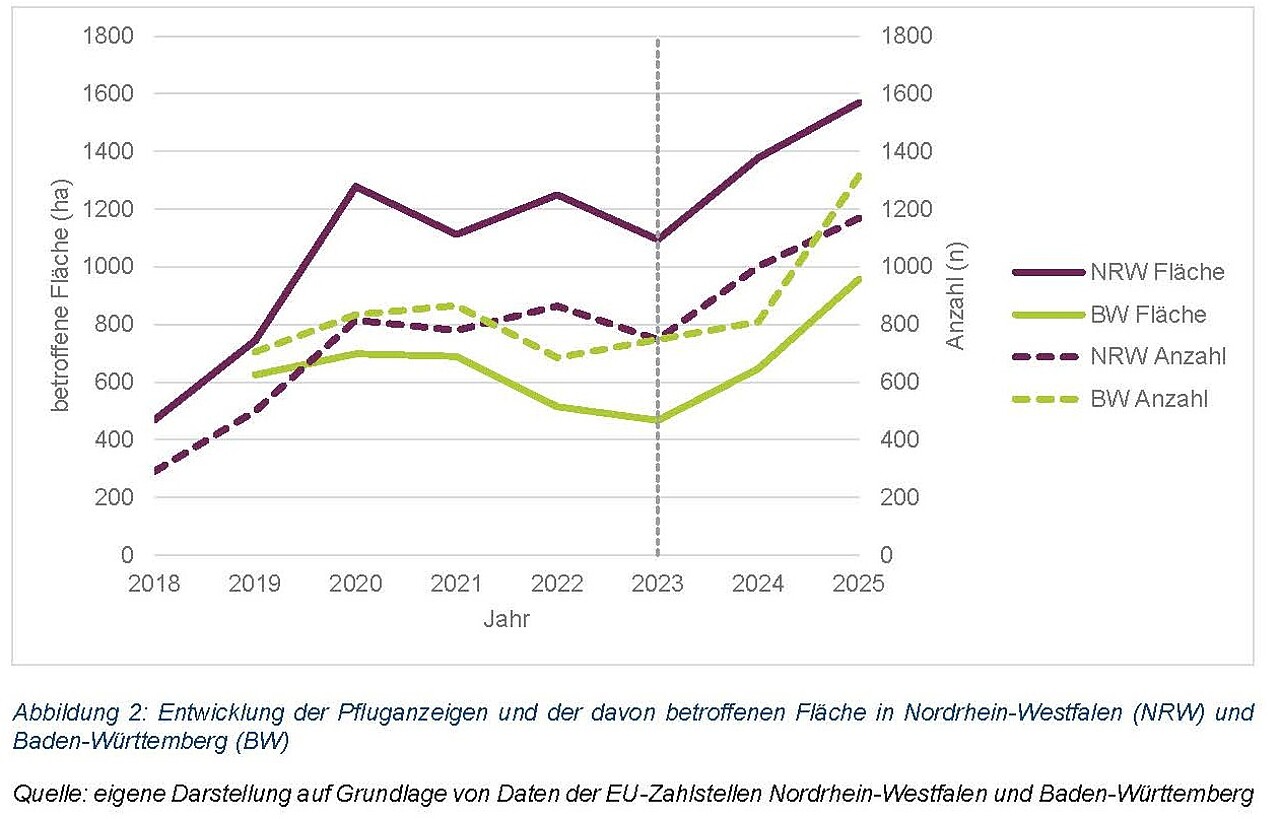
The master’s thesis combines quantitative and qualitative methods. For the quantitative analysis, the number and area of ploughing notifications per year were recorded for the period from 2018 to 2025. These data were analysed statistically with the software R using multiple linear regression models to examine:
- Is there a break in 2023, the year § 6 GAPKondG was introduced?
- Do the developments differ between NRW and BW?
The results were supplemented by expert interviews with representatives of the Farmers’ Association of Westphalia-Lippe (NRW) and the Farmers’ Association of Württemberg (BW).
What do the findings show?
The data show that in both states, the number and area of ploughing notifications increased over the years. The introduction of the new § 6 GAPKondG has so far changed this little. The politically stated expectation that ploughing notifications would decrease cannot be empirically confirmed by the master’s thesis.
On average, NRW has larger areas affected by ploughing notifications than BW. However, no significant difference can be detected in the development before and after 2023 between the two states. Despite different state laws, the trends are remarkably similar.
The interviews with the association representatives complement the statistical results. They indicate that legal uncertainty plays a major role: for § 6 GAPKondG to apply, the area must first become permanent grassland under subsidy law, even if it may later be ploughed up again. Many farms avoid exactly this intermediate status because they fear they may not be able to get rid of it later. In addition, the large number of legal areas involved (nature conservation, water, soil, protected areas) and authorities (paying agency, lower nature conservation authority, water authority, and others) increases this uncertainty. Despite environmental concerns, the ploughing notification is therefore seen as the “safer” route, because it clearly preserves arable status.
Policy implications
Several conclusions can be drawn from the master’s thesis:
A subsidy-law simplification such as § 6 GAPKondG has little effect if substantive law, for example nature conservation law in NRW, continues to impose strong restrictions on conversion or defines it ambiguously. The findings also show that rules on the preservation of permanent grassland cannot be viewed in isolation. Their practical impact depends largely on how they interact with existing substantive-law requirements and with the economic conditions faced by farms.
In the author’s view, it is questionable whether it is objectively necessary for each federal state to have its own definitions and rules for permanent grassland. Clearer, nationwide uniform rules could help standardise legal application and reduce arbitrary differences at different levels, such as between federal states or districts.
Why the topic remains relevant
Agricultural policy is shaped by a constant tension: how can climate and environmental protection goals be reconciled with planning security for farms? How can the right incentives be created for ecologically and economically sustainable agriculture? And how can complex rules be designed so that they remain workable for authorities and farms?
Hannah Gundlach’s master’s thesis contributes to these questions by showing that simplifications without clear, coordinated framework conditions often have little practical effect.
For feedback on this online article, please contact Anne Line Drescher.
For subject-related questions about the master’s thesis, please contact Hannah Gundlach.