
Details
Organic Farming in Iran: A Decade of Change [08.06.26]
A new study investigates the decline of organic farming in Iran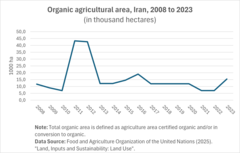
In recent years, organic farming has attracted global attention as a way to reduce reliance on agrochemicals, protect ecosystems, and promote more sustainable food systems. Worldwide, the area under organic cultivation has steadily expanded. In Iran, too, certified organic land expanded rapidly around 2010. Yet this momentum did not last. After stagnating at around 18,871 hectares for several years, the organic area began to decline around 2016.
So why has a sector with its associated benefits struggled to expand in Iran? What are the obstacles Iranian organic farmers face and the factors that have influenced the sector’s development? Researchers from the University of Hohenheim wanted to better understand that puzzle in their study “A Decade of Change and Future Prospects of Organic Farming in Iran Using the Multi-Round Delphi Method”. This article will summarize their findings and the factors they identified that have led to the decline of organic farming in Iran.
Showing the development of organic farming – the analytical approach
Understanding this puzzle requires looking at the various factors that influence organic farming and capturing the interactions between them. As one might expect, this is a complex task. The authors aim to examine not only policies and market structures related to organic farming in Iran, but also other relevant aspects, such as stakeholder values and skills, the coordination among institutions, leadership approaches, and the sector’s strategic direction. Considering these multiple dimensions, the authors selected one analytical framework from among several available options: the McKinsey 7S model.
The central assumption of this model is that achieving a specific goal (in this case, the successful development of organic farming in Iran) depends on the coordination of seven aspects: strategy, structure, systems, staff, skills, style, and shared values. Looking at those aspects and their interconnections helps reveal strengths and weaknesses within the organic sector in Iran. Moreover, using the different elements will help to pinpoint in which areas action needs to be taken to support organic farming in Iran in the future.
The analysis draws on expert interviews conducted in 2014 and repeated in 2024, complemented by a review of existing literature. By statistically comparing assessments from those two periods, the study provides insights into how different dimensions of the organic sector have evolved.
Reasons for hope in the organic sector
Overall, the study reveals encouraging progress in several areas.
- The authors identify improvements in planning and operational structures, particularly in the processing, packaging, and labelling of organic products in Iran.
- Critical structural components, including market infrastructure, certification systems, and the availability of organic inputs have also improved over the past decade.
- Another positive development is the growing awareness of environmental degradation and the benefits of sustainable agriculture. This increasing awareness appears to have played an important role in encouraging farmers to adopt organic practices.
- The most notable improvement is the strengthening of knowledge and awareness across the sector, suggesting that farmers’ expertise, managerial understanding, and consumer education have improved over time.
Continuing challenges
Despite this progress, several challenges remain unsolved in Iran. One notable obstacle is the lack of a unified regulatory framework, multiple and conflicting institutional responsibilities, and inadequate communication between critical stakeholders that might hinder effective implementation of organic policies in Iran.
Coordination among stakeholders remains weak, and the continued reliance on costly third-party certification poses challenges for smallholder farmers seeking certification. Based on the interviews with experts, the authors find that the dedicated departments or units working on organic agriculture continue to be understaffed or lack specialization, a situation which has continued to exist over the years.
One of the biggest barriers in organic farming in Iran remains the lack of governmental and financial support.
Implications for future development
The findings suggest that, despite advances in capacity and growing public support, structural and policy limitations remain key obstacles to the sector’s expansion. Still, the authors are cautiously optimistic that organic farming in Iran holds considerable potential and that the identified challenges can be addressed.
To support further development, the authors propose several concrete actions for policymakers. These include:
- developing a national plan for organic agriculture to improve alignment among governmental institutions, research organizations, and producer groups.
- establishing a comprehensive training and capacity-building system could help prepare specialists, extension officers, and farmers to support the organic transition.
- Updating certification procedures,
- improving operational guidelines, and
- strengthening market infrastructure would further facilitate the growth of the organic sector.
Additional information
Source for visualization: Food and Agriculture Organization of the United Nations (2025). "Land, Inputs and Sustainability: Land Use". Available at: https://www.fao.org/faostat/en/#data/RL Last accessed: 10.03.2026
This online article is based on the study: Babajani, Arezou & Rahmati, Faezeh & Rafizadeh, Neda & Zikeli, Sabine & Wieck, Christine. (2025). A Decade of Change and Future Prospects of Organic Farming in Iran Using the Multi‐Round Delphi Method. Futures & Foresight Science. 7. doi.org/10.1002/ffo2.70028 
Contact
For any feedback on this online article please contact Anne Line Drescher.
For further questions related to the research content, please contact Arezou Babajani (arezou.babajani@uni-hohenheim.de), one of the authors of the original article.
