
Details
To be or not to be? Profitability and exit decisions of organic dairy farmers in the EU [22.04.26]
Organic farming is often seen as both a climate solution and a market opportunity. But if organic is so promising, why do some farms return to conventional production or even exit farming altogether? What are implications for the Farm to Fork Strategy’s target to manage 25% of agricultural land organic by 2030. A recent study on organic dairy farms in the six biggest dairy producers in the EU looks at profitability and exit decisions in detail.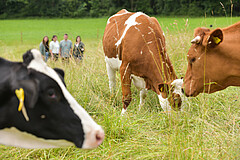
Organic farming on the rise and a new reverse trend
Organic farming has been on the rise so far: globally, the share of organically managed land has increased and the same applies to the EU. In 2021, about 10.5% of agricultural land was farmed organically - a share that, according to the European Commission’s Farm to Fork Strategy, should rise to 25% by 2030. However, a reverse trend has emerged[AB1.1]: some organic farms have reverted to conventional production or even exited farming altogether.
A study by Heinze and Vogel (2017) shows that 30% of the farms that converted to organic production between 1999 and 2003 had reversed that decision by 2010 and returned to conventional farming. This raises key questions addressed by the authors of a recent study:
- How profitable is organic farming compared to conventional farming?
- And when farms abandon organic production, what are their reasons and what role does profitability play in that decision?
Why dairy farming?
The authors focus on a specific sector: dairy farming. Why this sector in particular? Because dairy farming occupies a special position within the organic sector for several reasons.
On the one hand, cows (as ruminants) contribute significantly to greenhouse gas emissions and climate change. On the other hand, they make it possible to use grassland efficiently, which in some regions, cannot easily be used for crop production. In such areas, cattle farming is also a traditional element of the cultural landscape. However, by now, it should be clear that not all cows graze idyllically in mountain pastures. Animal welfare has become an increasingly important concern in livestock farming, one that organic agriculture seeks to address. And lastly, many farmers complain about low prices and high costs.
The study analyzes the financial situation of about 28,000 dairy farms in France, Germany, Italy, the Netherlands, Poland, and Spain between 2004 and 2017, covering roughly 71% of EU milk production. The authors evaluate these results statistically and describe their methodology in detail in the original paper.
Key finding: Organic more profitable on average – with large variation
For those who don’t want to go through the full results, here are some key insights: on average, organic farms are about 2.7 percentage points more profitable than conventional ones. In other words: If a conventional dairy farm earns, say, a 5% profit on the value of everything it owns (its buildings, land, cows, machines), then a comparable organic dairy farm would on average earn about 7.7% instead. However, the size of that advantage changes over time.
The fact that some farms still give up organic dairy production, despite higher profits on average[AB5.1], can be explained by several factors:
- The additional profit of organic farms (the so-called profitability premium) can fluctuate greatly from year to year. When price uncertainties are high, risk-averse farmers may be more likely to exit the organic market.
- Organic dairy farms need several years to establish themselves and meet new requirements, for example, in feeding or veterinary practices which increases costs further. These challenges persist beyond the first two years after conversion and peak roughly eight years after the initial transition.
Rethinking support: From short-term conversion aid to long-term stability
Therefore, it might be worth rethinking how support for organic farming is designed. Instead of one-off or short-term subsidies in the early years (as is often the case now), long-term measures to stabilize farm incomes could be more effective.Alternatively, targeted support during certain post-conversion phases or for specific regions could also prove beneficial.
The authors also found that financial support in the form of subsidies can prevent organic dairy farms from abandoning organic production. However, more research is needed, as this finding applies only to a limited period within the data set.
Conclusion and open questions
Their conclusion is clear:
If the goal is to further expand organic farming in the future, the question remains under which economic conditions it becomes attractive for farmers. In other words, significant knowledge gaps still exist regarding the financial viability of organic farming — not just in dairy production but across other agricultural sectors as well.
This online article is based on the original study:
Stefan Hirsch, Ayoub Barissoul, Niklas Möhring, Max Koppenberg. Profitability and exit decisions of organic dairy farmers in the EU. Food Policy, Band 139, 2026, https://doi.org/10.1016/j.foodpol.2026.103034.
For any feedback on this online article please contact Anne Line Drescher.
For further questions related to the research content, please contact Ayoub Barissoul, one of the authors of the original article.
